
As Muslims, we understand the importance of managing our finances with diligence and care. From where we store, invest, and spend our money, we take measures to ensure that our financial dealings align with our faith.
Just as we wouldn't entrust our money to anyone without proper vetting, we should be equally conscious when it comes to financial products positioned as Islamic, Halal or Shariah Compliant.
Particularly in Malaysia, where Muslims account for nearly 64% of the population and Islam is the primary religion, products and offerings made to Muslim is often distinguished from conventional ones. As such you’ll find everything from Islamic Saving Accounts to Shariah compliant mortgages.
While it may appear complicated to vet for authentic Shariah compliance in financial engagements, understanding the core principles can serve as a starting point for assessing these readily available products - instead of taking them up as advertised, without vetting.
Understanding Shariah Compliance
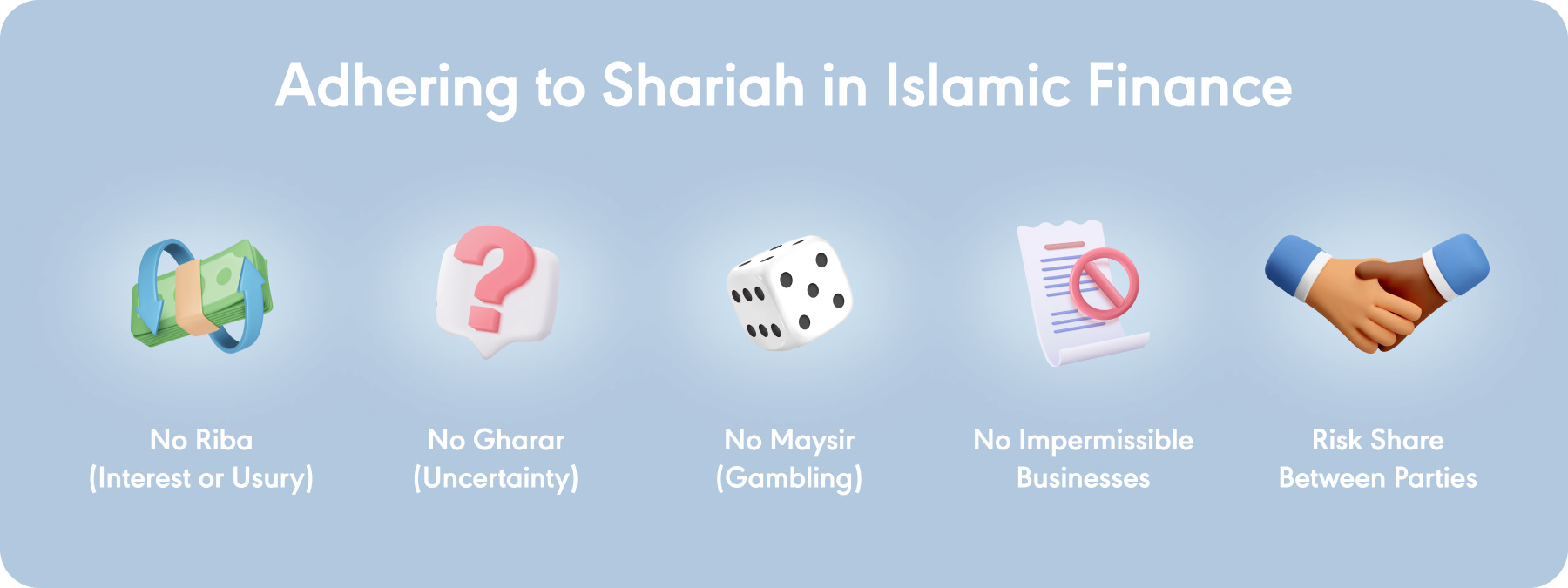
To effectively assess Shariah compliance, it's essential to grasp the core principles that underpin it. These principles, derived from the Qur'an and Sunnah, form the ethical and moral framework for all Islamic financial engagements.
Prohibition of Riba (Interest)
One of the most fundamental principles is the prohibition of riba, or interest.
The Qur'an states:
وَأَحَلَّ ٱللَّهُ ٱلْبَيْعَ وَحَرَّمَ ٱلرِّبَوٰا۟
"Allah has permitted trade and has forbidden interest" (Surah Al-Baqarah: Ayat 275).
In its most common form, riba is the addition of an extra amount to the original transaction. For example, a bank loan of RM 1000, but having to return RM 1100, whether that's agreed upfront or incurred due to missed repayment.
A simple way to filter for a riba transaction is to assess whether it's a money-for-money exchange, with the exception of spot foreign exchange, which has technicalities of its own.
Prohibition of Gharar (Uncertainty)
Gharar refers to excessive uncertainty or ambiguity in a transaction.
Abu Hurairah (ra) narrated: "The Messenger of Allah (saw) prohibited the gharar sale, and the hasah sale" (Tirmidhi 1230).
Financial transactions must be transparent, with clear terms and conditions, and must not involve any form of gambling or speculative activities.
For example, a fisherman may choose to sell a fixed amount of fish before acquiring the fish. This instance carries uncertainty of the fisherman catching the committed amount of fish, in an undefined time period, without control of the quality of fish.
A simple way to filter for gharar engagement is to assess whether more questions are unanswered than answered.
Prohibition of Maysir (Gambling)
Maysir is gambling or speculation, where gains are derived from mere chance.
The examples of which present themselves, any income gained through wagering bets on a sporting event.
A comparison which is fitting to include here is that of trade. Businesses come with risk, which may pose the question of whether it could be considered "maysir", however, in the Qur'an there is an explicit approval of trade, as previously cited:
وَأَحَلَّ ٱللَّهُ ٱلْبَيْعَ وَحَرَّمَ ٱلرِّبَوٰا۟
"Allah has permitted trade and has forbidden interest" (Surah Al-Baqarah: Ayat 275).
Prohibition of Impermissible Business
As Muslims, we have a way of life that navigates our avoidance of things that are impermissible or displeasing to Allah.
By extension, our money should not be fuelling these transgressions either. Business activities such as
- Tobacco
- Alcohol
- Firearms
- Gambling
- Adult entertainment
- Impure food stocks
- Usurious institutions
Away from the nature of a business, which is relatively easy to determine, Shariah standards also define excessive debt as impermissible. The benchmarks outlined by Shariah bodies differ through expert conclusions of their own.
Risk Sharing
Core to Shariah compliance in finance is the concept of sharing risk, or profit and loss sharing, referred to as musharakah.
This means that both parties in a financial engagement share the risks and rewards in a predetermined ratio, enabling fairness and equity for all stakeholders.
To demonstrate, two friends open a business contributing RM 6000 and RM 4000 respectively. With that, their ratio would be 60/40, and in the instance of profit distribution, they would take the according profit.
Applying Shariah Principles in Malaysia
While Malaysia has a well-developed Islamic finance industry, it is essential that consumers critically evaluate the products and services offered.
For example, some Islamic banks or investment products provide fixed returns, but are these truly aligned with the principles of risk sharing or riba, considering your deposits could be invested or loaned out?
It is our responsibility to ask these questions as part of our Ehsan, seek clarity, and ensure that the products and services we use are truly in line with our beliefs and Shariah principles. We should not hesitate to engage with Islamic financial institutions, question practices, and demand transparency.
Wahed's Commitment to Shariah Compliance
At Wahed, our claim of riba-free investing is coupled with the highest standards of Shariah adherence.
Our portfolios are carefully screened to ensure that they only include Shariah-compliant assets. The screening process involves both financial and non-financial criteria, ensuring that the companies included do not engage in prohibited business activities and meet certain financial ratios.
Moreover, we have an external Shariah advisory board, consisting of renowned Islamic scholars, who review and approve all our investment products and strategies. This ensures that our offerings are always in line with the principles of Shariah.
As Muslims, it is our duty to be informed, critical, and proactive consumers. By understanding the core principles of Shariah and applying them in our evaluation of financial products and services, we can ensure that our wealth is managed in a way that is pleasing to Allah.